
Smart home systems are no longer limited to motion sensors, smart bulbs, and security cameras. Modern automation platforms like Home Assistant can now use a regular Windows PC as a powerful sensor for tracking activity, presence, hardware status, and even environmental conditions.
Many users overlook the fact that a desktop or laptop computer is constantly generating useful data. By connecting a PC to Home Assistant, it becomes possible to automate lights, climate settings, notifications, and other smart devices based on what the computer is doing in real time.
This turns a standard Windows PC into a valuable part of a smart home ecosystem.
What Does It Mean for a PC to Be a Sensor?
In Home Assistant, a sensor is simply a device or software component that provides information. While most people think of temperature or motion sensors, a Windows computer can provide far more advanced data.
For example, Home Assistant can detect:
- Whether the PC is turned on or asleep
- CPU and GPU temperatures
- Network activity
- Battery status on laptops
- Active applications
- Webcam or microphone usage
- Keyboard and mouse activity
- System performance statistics
- Storage usage
- Power consumption
Once this information is available inside Home Assistant, automations can react instantly.
A smart home setup could automatically:
- Turn off lights when the PC shuts down
- Enable gaming room RGB lighting when a game launches
- Activate silent mode during work hours
- Send overheating alerts
- Pause robot vacuums while the PC is in use
- Change room temperature while gaming
This creates a much more intelligent automation experience than relying only on basic motion sensors.
How Windows Integrates With Home Assistant
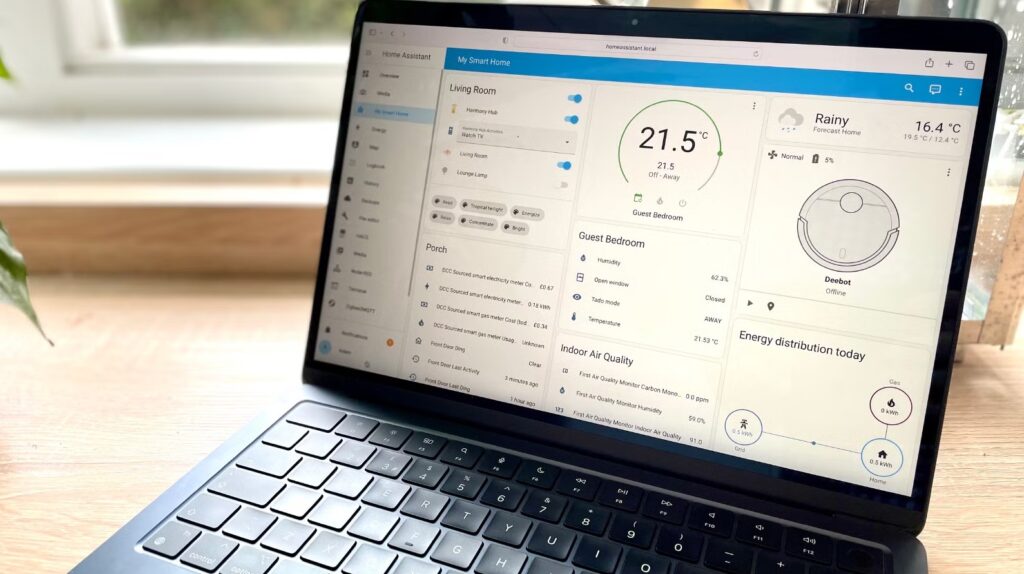
The most common method is through the official Home Assistant Companion app or third-party integrations that expose Windows system information to the Home Assistant dashboard.
After setup, the PC appears as a connected device with multiple entities and sensors.
Some integrations can report:
- System uptime
- RAM usage
- CPU load
- Disk health
- IP address changes
- Wi-Fi connection state
- User login activity
Gamers and power users especially benefit from this because powerful PCs already contain dozens of hardware sensors that can be reused for home automation.
For example, if GPU temperature rises during gaming sessions, Home Assistant could automatically increase fan speed in a smart room or activate a connected air conditioner.
Presence Detection Becomes More Accurate
One of the biggest advantages of using a PC as a Home Assistant sensor is better presence detection.
Traditional presence tracking often relies on smartphones, which are not always reliable. Phones may disconnect from Wi-Fi, enter battery-saving modes, or fail to update location correctly.
A Windows PC provides another layer of confirmation.
If keyboard or mouse activity is detected, Home Assistant knows someone is actively using the room. This allows automations to become much smarter.
For example:
- Lights stay on while the PC is active
- Smart speakers reduce volume during gaming
- Notifications only appear when someone is present
- Energy-saving automations wait until the PC is idle
This helps avoid false triggers and improves automation reliability.
Gaming PCs Work Especially Well
Gaming computers are ideal Home Assistant sensors because they already monitor temperatures, fan speeds, and hardware performance continuously.
RGB lighting ecosystems such as:
- Corsair iCUE
- ASUS Aura Sync
- Razer Chroma
- Logitech G Hub
can often be integrated into Home Assistant workflows.
This allows advanced automations such as:
- Synchronizing room lighting with game launches
- Changing LED colors based on CPU temperature
- Flashing lights during alerts or notifications
- Automatically enabling streaming scenes
A gaming setup can become fully connected to the rest of the smart home.
Privacy and Security Considerations
As with any smart home integration, privacy matters.
Users should only install trusted Home Assistant integrations and avoid exposing PC monitoring tools directly to the internet. Running Home Assistant locally is generally considered safer because data stays inside the home network.
It is also recommended to:
- Use strong passwords
- Enable two-factor authentication
- Keep Home Assistant updated
- Avoid unnecessary remote access
Proper configuration helps prevent security risks while still allowing powerful automation features.