
Working in Microsoft Excel becomes frustrating when text suddenly gets cut off or hidden inside a cell. You may start typing only to realize that part of your content disappears because the column or row is too small.
Fortunately, Excel provides simple tools to resize cells so your text fits perfectly. In this guide, you’ll learn how to expand columns, rows, and individual cells so your worksheet remains clean, readable, and organized.
Understanding Excel Cell Size Limits
Excel determines column width and row height using a point-based measurement system. In practical terms, one point roughly corresponds to the width of a standard character in Excel’s default font.
Because of this system, columns and rows can only expand up to certain limits.
| Type | Default Size | Maximum Size |
|---|---|---|
| Column | 8.43 points (64 pixels) | 255 points (1790 pixels) |
| Row | 15 points (20 pixels) | 409.5 points (546 pixels) |
Both rows and columns can also be set to 0, which hides them instead of resizing them.
Tip: If your text still doesn’t fit after reaching the maximum size, enable Wrap Text or divide the content into multiple cells.
How to Expand Excel Cells Automatically (AutoFit)
The quickest way to make text fully visible in Excel is by using the AutoFit feature. AutoFit automatically adjusts the column width or row height based on the content inside the cells.
Expand a Column to Fit Text
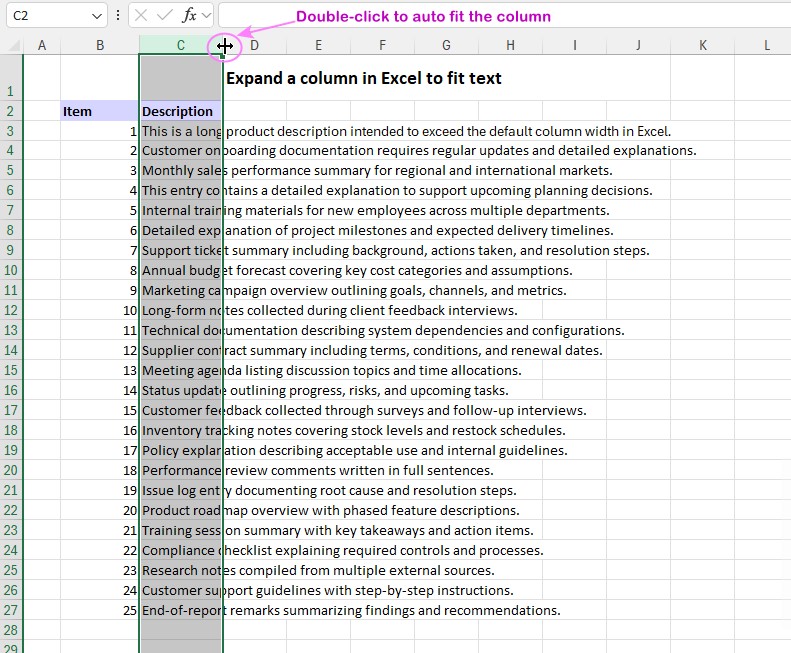
If text appears cut off or overlaps other cells, you can quickly resize the column:
- Select the column you want to adjust.
- Move your cursor to the right edge of the column header.
- When the cursor changes into a double-arrow icon, double-click.
Excel will instantly resize the column so it fits the longest piece of text in that column.
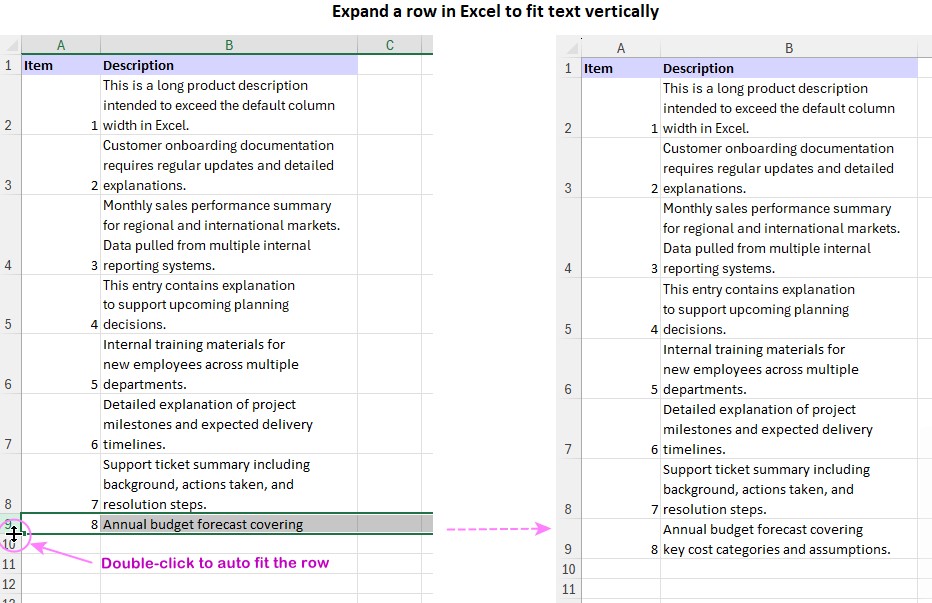
Expand a Row in Excel to Fit Text
If the content inside a cell appears cut off vertically, you can quickly resize the row so the entire text becomes visible. This is especially useful when working with wrapped or multi-line text in Microsoft Excel.
The easiest way to fix this is by using Excel’s AutoFit Row Height feature.
Steps to Expand a Row Automatically
Follow these simple steps to make a row expand based on its content:
- Select the row you want to resize.
- Move your cursor to the bottom edge of the row number on the left side of the worksheet.
- When the cursor changes to a double-headed arrow, double-click.
Excel will instantly adjust the row height so that all the text within the cells becomes fully visible.
This method works particularly well when Wrap Text is enabled, as Excel automatically increases the row height to accommodate multiple lines of text without cutting off any content.
AutoFit Multiple Columns or Rows at Once in Excel
When working with large spreadsheets in Microsoft Excel, resizing columns or rows one by one can take unnecessary time. Fortunately, Excel allows you to automatically adjust multiple columns or rows simultaneously using the AutoFit feature.
How to AutoFit Several Columns or Rows
Follow these steps to resize multiple columns or rows at the same time:
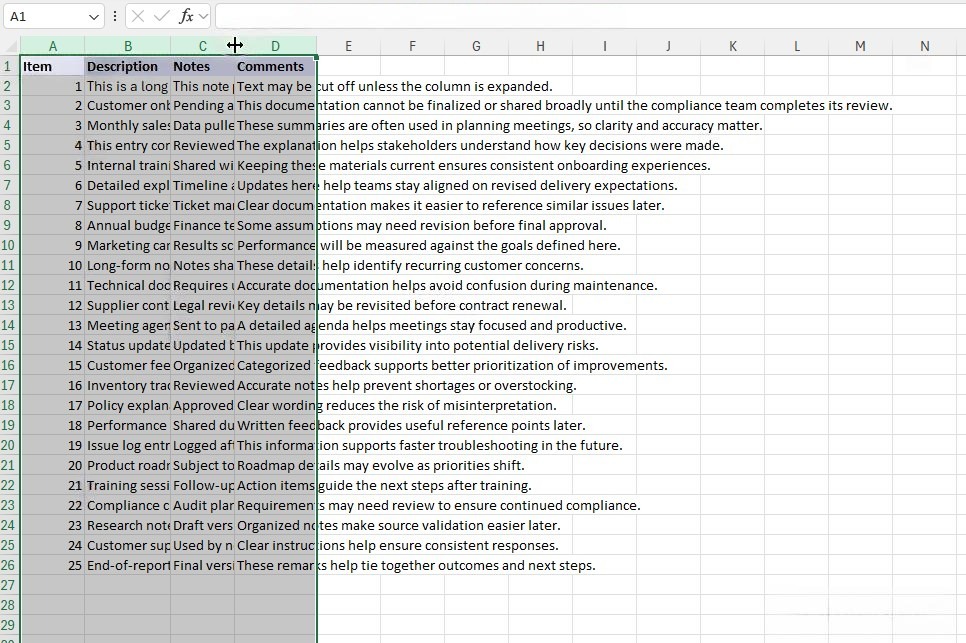
- Select the columns or rows you want to resize.
- Move your cursor to the border between any two selected column headers or row numbers.
- When the cursor changes to a double-headed arrow, double-click.
Excel will automatically adjust the size of all selected columns or rows so the content inside each cell fits properly.
This method is particularly useful when cleaning up large datasets or preparing spreadsheets for reports, ensuring that all text remains clearly visible without manual resizing.
Important Note When Using AutoFit
When adjusting multiple rows or columns in Microsoft Excel, make sure you double-click the boundary between columns or rows that are part of your selection.
If you double-click the right edge of only the last selected column or the bottom edge of the last selected row, Excel will resize only that single column or row, instead of applying AutoFit to the entire group.
Paying attention to where you double-click ensures that all selected columns or rows are resized correctly.
Manually Resize Excel Columns and Rows by Dragging
Sometimes AutoFit is not the best option, especially if you want precise control over spacing and layout. In these cases, you can manually resize columns or rows by dragging their borders.
This method allows you to visually adjust cell sizes exactly how you want them.
Steps to Resize Columns or Rows Manually
- Select the column or row you want to resize.
- Move your cursor to the right border of the column header or the bottom border of the row number area.
- When the cursor changes to a double-headed arrow, click and drag the border to the desired size.
Manual resizing is particularly useful when formatting spreadsheets for presentations, reports, or printed documents, where consistent spacing and layout are important.
This approach is particularly helpful when you are designing the layout of a worksheet, such as aligning columns evenly or adding extra space to improve readability in Microsoft Excel.
Tip: To resize multiple columns or rows at the same time, select them first and then drag any border within the selection. Excel will adjust all selected columns or rows together.
Expand Excel Cells Using the Format Menu
If you need to set exact column widths or row heights, the Format menu offers more precise control than dragging borders or using AutoFit. This method is useful when you want consistent spacing regardless of the content inside the cells.
Resize Columns in Excel
To define a precise column width, follow these steps:
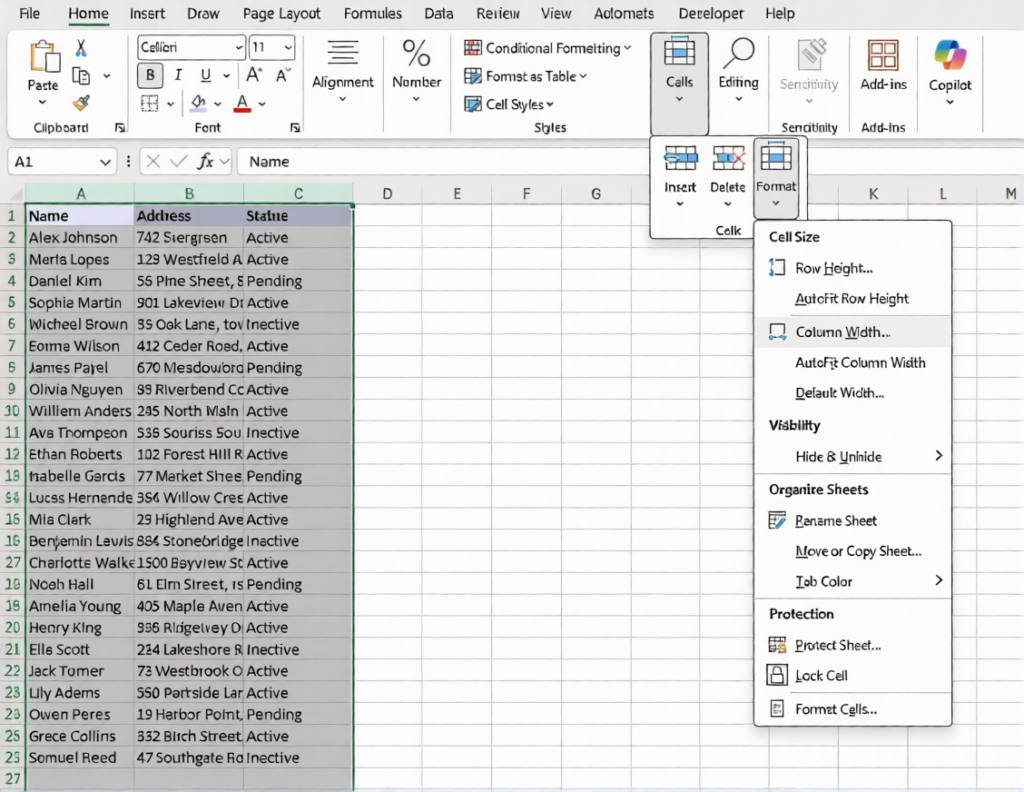
- Select one or more columns you want to resize.
- Go to the Home tab.
- In the Cells group, click Format.
- From the drop-down menu, choose one of the following options:
Column Width – Opens a dialog box where you can enter an exact width value. All selected columns will be set to the same width, regardless of their content.
AutoFit Column Width – Automatically adjusts the selected columns to fit the longest value in each column. This works the same way as double-clicking the column border.
Default Width – Changes the default width used for new or empty columns in the worksheet. Existing columns that already contain data will remain unchanged. You can also apply a default width to multiple worksheets by selecting their sheet tabs before using this option.
Resize Rows in Excel
The Format menu also allows you to control row height with precision.
Row Height – Opens a dialog box where you can enter an exact height value for the selected rows.
AutoFit Row Height – Automatically adjusts the row height so that all wrapped or multi-line text is fully visible inside the cells.
Using the Format menu is ideal when you want consistent column widths and row heights, especially when preparing spreadsheets for reports, printing, or professional presentations.
How to Make Excel Cells Expand to Fit Text Vertically
Sometimes the issue is not the column width, but the fact that all the text appears on one long line. When this happens, the content may extend beyond the visible area of the cell. In Microsoft Excel, the Wrap Text feature solves this problem by placing the text on multiple lines within the same cell.
When Wrap Text is enabled, Excel automatically increases the row height so the entire content becomes visible. This feature is particularly useful for long descriptions, notes, comments, or paragraph-style text inside a worksheet.
How to Wrap Text in Excel
Follow these simple steps to make text expand vertically within a cell:
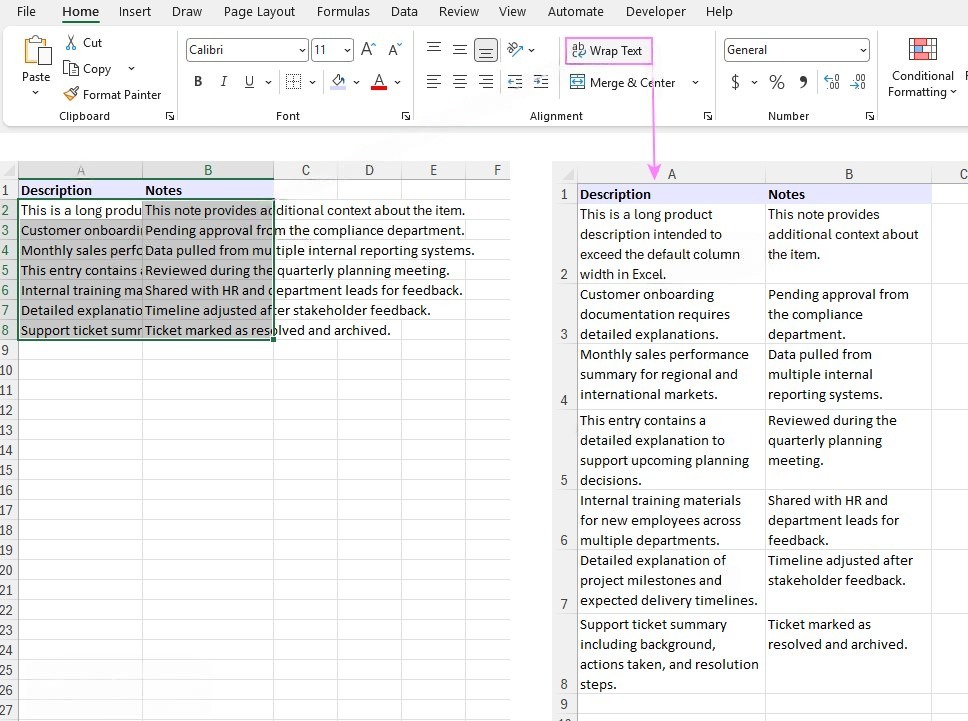
- Select the cell or cells that contain the text.
- Go to the Home tab on the ribbon.
- In the Alignment group, click Wrap Text.
Once enabled, Excel will automatically wrap the text onto multiple lines and adjust the row height so the content fits neatly within the cell.
This method helps keep spreadsheets organized and easy to read, especially when working with longer pieces of text.
Tip: Use AutoFit After Applying Wrap Text
If the text is still not fully visible after enabling Wrap Text in Microsoft Excel, try using AutoFit on the affected rows. This usually occurs when the row height was previously set to a fixed value.
Wrap Text ensures that content stays inside the cell instead of spilling into neighboring cells, while AutoFit Row Height adjusts the row size so the entire wrapped text becomes visible.
Make Excel Columns the Same Width
When working with large spreadsheets, consistent column sizes can make your data easier to read and visually cleaner. Excel allows you to copy the width of one column and apply it to others using the Paste Special feature.
How to Copy Column Width in Excel
- Select the column that already has the desired width (or click any cell inside that column).
- Press Ctrl + C to copy it.
- Select the columns where you want to apply the same width.
- Right-click the selection and choose Paste Special.
- Select Column Widths, then click OK.
All selected columns will now match the width of the original column.
Faster Method Using Keyboard Shortcuts
You can perform the same action entirely with shortcuts:
- Press Ctrl + Alt + V to open the Paste Special dialog.
- Press W to select Column Widths.
- Press Enter to apply the change.
This technique is particularly useful for tables, reports, and dashboards, where uniform column widths improve readability and structure.
How to Expand All Columns in an Excel Worksheet
If your spreadsheet contains many columns with the same default width, you can expand them all at once.
Step 1: Select All Columns
You can select the entire worksheet in one of two ways:
- Press Ctrl + A (Windows) or Cmd + A (Mac).
- Click the Select All button in the top-left corner of the grid (the small triangle between row numbers and column letters).
Step 2: Choose a Resizing Method
Once everything is selected, you can resize the columns using one of these options:
AutoFit Columns
Double-click any column border in the header row. Excel will resize each column to fit the longest value within it.
Drag to Resize
Click and drag any column border to the right. All selected columns will expand to the same width.
Set an Exact Width
Go to Home → Format → Column Width, enter a number, and click OK. Excel will apply that exact width to every selected column.
Tip:
Use AutoFit when you want columns sized according to their content. If you prefer a consistent layout across the worksheet, manually dragging or setting a numeric width is usually the better option.
How to Enlarge Specific Cells in Excel
Sometimes you may want a single cell or small group of cells to appear larger without affecting the rest of the worksheet. However, Excel does not allow resizing an individual cell independently.
In Excel’s grid structure, changing the width affects the entire column, while adjusting the height affects the entire row.
Workaround: Merge Cells
A common solution is to merge multiple cells together to create a larger space.
- Select the adjacent cells you want to combine.
- Go to the Home tab.
- In the Alignment group, click Merge & Center.
Excel will combine the selected cells into one larger cell and center the text by default. You can adjust the alignment afterward if needed.
Note: When merging cells, Excel keeps only the value from the upper-left cell. Any content in the other selected cells will be removed. To avoid losing information, merge only empty cells or copy the data elsewhere first.